All Programs
Free on iPhone
Dranyen
སྒྲ་སྙན
A tuner, a playable instrument, and a library — for the Tibetan lute at the heart of a thousand years of music.
Built in collaboration with Tenzin Norbu (Tenor), with guidance from Jhola Techung, Phurbu T. Namgyal, and Karma Drukya.
Download on theApp StoreFree · No account · Works offline · iPhone (iOS 13+)
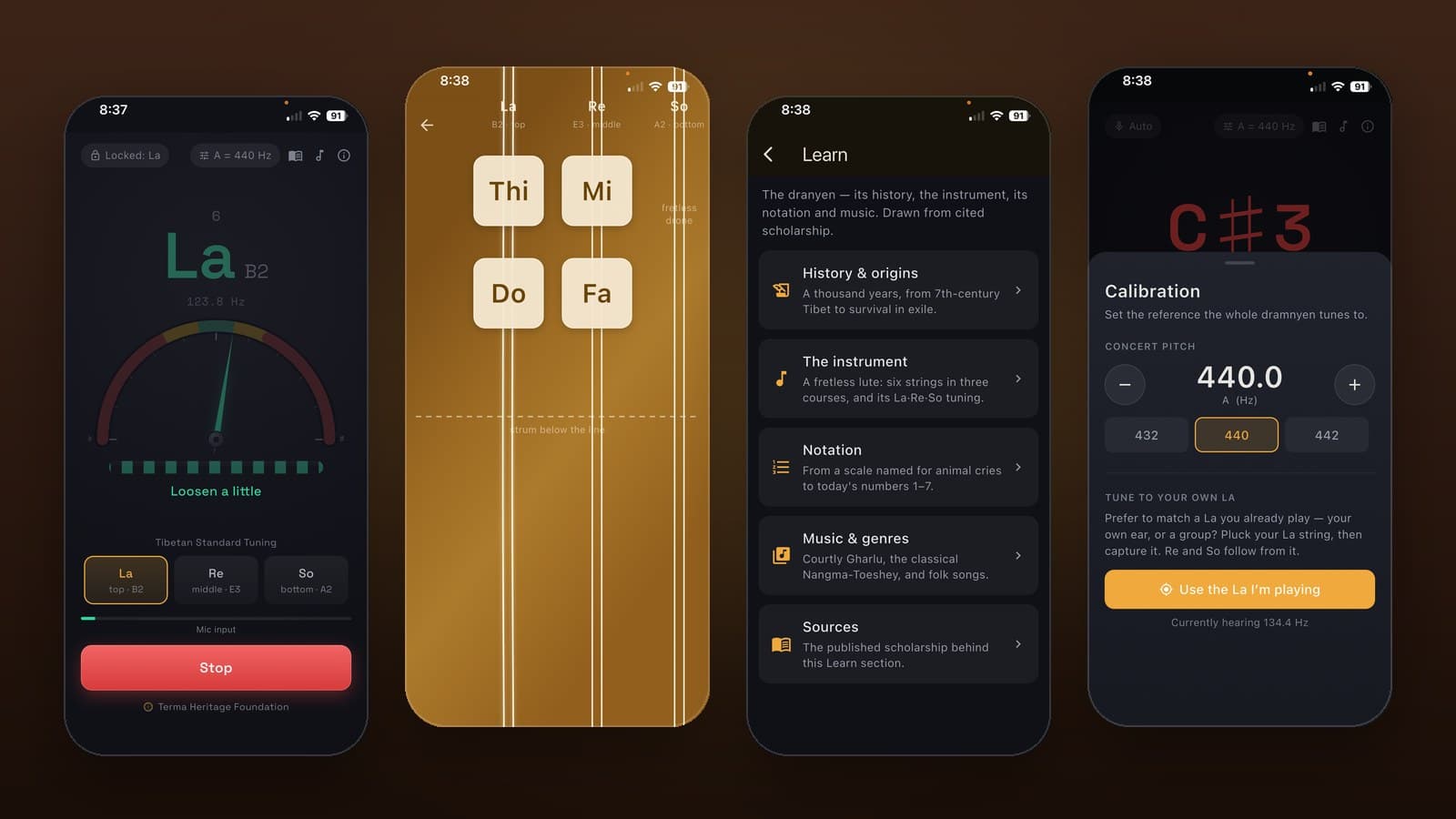
In countless Tibetan homes, the dranyen hangs on the wall as an heirloom — beautiful, and silent. This app gives it its voice back.
Why a tuner matters
A dranyen is only alive when it can be played in tune. Two small problems have quietly held the tradition back — and both have a simple answer.
From decoration back to instrument
Without an accurate way to tune it, a dranyen becomes a decoration — and for many families whose instrument sat untuned, that is exactly what it became. With a reliable tuner in every pocket, the lute on the wall can be picked up and played again, breathing life back into a thousand-year-old tradition.
One standard tuning
The dranyen is tuned with slight variation across the regions of Tibet, so even players who know how to tune set their pitch differently — and when two of them meet, a performance can begin with the two musicians tuning to each other on stage. Built in collaboration with some of the most renowned Tibetan musicians in exile, Dranyen offers a single, confirmed standard tuning that players everywhere can share.
Three tools in one
Tune it, play it, and learn where it comes from — all in a single, quiet app.
A tuner, in your pocket
Real-time pitch detection listens through the microphone and shows, at a glance, whether a string is sharp or flat. A glowing gauge names the note in both solfège and numbers, and gently confirms when you land in tune. Tune by the three open courses — La · Re · So.
A dranyen you can play
Strum the three open courses and the fretted notes to hear how the instrument sounds — voiced from recordings of a real dranyen, with a fretless So drone, so it rings the way the instrument actually does.
A library you can read offline
A built-in guide to the instrument and its world, drawn from cited scholarship: history and origins, how it is built, its notation, and the genres it carries — from courtly Gharlu to the classical Nangma-Toeshey.
The instrument
A long-necked, fretless plucked lute — warm, resonant, and unmistakably Tibetan in silhouette.
Usually hollowed from a single piece of wood and roughly 60 to 120 cm long, the dranyen has a two-waisted body whose soundboard carries rosette-shaped openings in the manner of old European lutes, with the lower bout often closed by a stretched skin membrane. The neck ends in a carved finial — most often a horse’s head — and its tuning pegs are traditionally said to take the shape of the phurba, the ritual dagger. Six strings sit in three double courses, each pair tuned in unison.
The tuning — three open courses
| Course | Solfège | Pitch | Frequency |
|---|---|---|---|
| 1st (open) | La | B2 | 123.47 Hz |
| 2nd (open) | Re | E3 | 164.81 Hz |
| 3rd (open) | So | A2 | 110.00 Hz |
In D major (A = 440 Hz), confirmed with a master player. Two degrees are re-entrant — So and La sound an octave below the rest — and the paired strings sit a few cents apart, so they gently shimmer against one another.
A thousand years
The name dranyen joins two syllables — dra (tune) and nyen (melody) — and is best rendered “the instrument of melodious sound.” Most accounts place its emergence around the 7th century, during the reign of King Songtsen Gampo, read from murals at Samye, the Jokhang, and the Potala that show the king entertained by court minstrels.
Its golden age came after the Great Fifth Dalai Lama established the Ganden Phodrang government in 1642: the master musician Tashi was invited to Lhasa to set down the instrument’s root text, and the classical genre Nangma-Toeshey was composed for the first time. Lyrics from that courtly tradition still circulate — including the famous quatrain attributed to the Sixth Dalai Lama, foretelling his own rebirth:
White crane! Lend me your wings, I will not fly far — from Lithang, I shall return.
— attributed to the Sixth Dalai Lama
After 1959, traditional genres were banned outright during the Cultural Revolution. In exile, the Tibetan Institute of Performing Arts (TIPA), founded in 1959 under the patronage of His Holiness the 14th Dalai Lama, became the heart of preservation — training hundreds of artists and, in 1993, publishing the first songbook of Nangma-Toeshey with lyrics and notation.
That lineage runs directly into this app: among TIPA’s leading performers is Tenzin Norbu (“Tenor”), who trained under master Gonpo Dorjee — the musician whose recordings give Dranyen its sound.
Notes named for animals
The Great Dungkar Dictionary records a seven-note scale in which each degree is named for the voice of an animal — a poetic naming of the solfège that today is written simply as the numbers 1–7.
| № | Sol-Fa | Tibetan | Animal voice |
|---|---|---|---|
| 1 | Do | Druk-kye | Cry of the peacock |
| 2 | Re | Drang-song | Lowing of the bull |
| 3 | Mi | Sa-zin | Bleating of a goat |
| 4 | Fa | Bhar-ma | Call of the heron |
| 5 | So | Nga-dhen | Call of the cuckoo |
| 6 | La | Los-sel | Neighing of the horse |
| 7 | Ti | Khor-nyen | Trumpeting of the elephant |
The music it carries
From the courts of the Dalai Lamas to circle-dances after the harvest, the dranyen has carried many kinds of music.
Gharlu
Courtly music — said to comprise 74 compositions performed for the Dalai Lamas and at the banquets of the Lhasa nobility.
Nangma
The elegant, leisurely classical song-form that rose to prominence under the Fifth Dalai Lama in the 17th century.
Toeshey
Named for the Toe region of western Tibet — the brisker circle-dances of harvests, weddings, and gatherings.
Folk & street songs
The songs of farming and herding, and the Lhasa street songs that once served as public satire for ordinary citizens.
The road ahead
The tuner is only the beginning. What comes next turns the app from a tool into an archive of living melody.
Planned
Notation for Nangma songs
The classical Nangma-Toeshey repertoire, written in the living numbered notation so it can be read, taught, and played.
Planned
Record & transcribe
A record feature that turns what you play into traditional numbered notation and Western sheet music — capturing melodies that have only ever been passed down by ear.
Planned
And more to come
Dranyen is the first piece of a small ecosystem the Foundation is building around the instrument and the people who play it.
Made With the Masters
A tuning confirmed by those who carry the tradition
Dranyen was developed by Thupten Chakrishar in collaboration with Tenzin Norbu (former TIPA artist), with guidance from Jhola Techung, Phurbu T. Namgyal, and Karma Drukya. Its Learn section is built on cited scholarship — principally Tashi Tenzin’s Dranyen: A Study in Tibetan Identity (Tibet Policy Institute) — with deep gratitude to the Tibetan Institute of Performing Arts.
Private by design
No accounts, no tracking, no ads. The microphone is used only to detect pitch, live, on your device — your audio is never recorded, saved, or sent anywhere. The app works fully offline.
Built openly
Developed in the open by the Terma Heritage Foundation, with the instrument’s artwork and tuning data verified against master players and recordings.
View on GitHubGive the dranyen its voice back
Free, offline, and private. Tune the lute on the wall and play it again.
iPhone · iOS 13+ · Free
“For a thousand years this instrument has carried our songs. May it keep singing for a thousand more.”