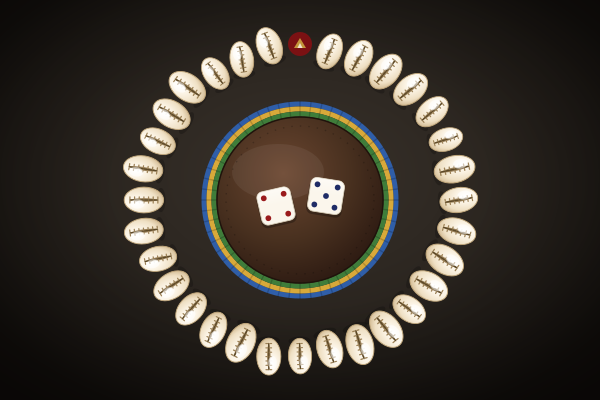
What is sho?
Sho (ཤོ་) simply means “dice.” The word stands for the dice, for a throw, and for the whole game built around it — properly sho rtsed, “dice-play.” To play is sho rgyag, “to throw sho.” For at least a century, Western observers have called it the national game of Tibet: the colonial officer Charles Bell, who lived in the region for over a decade, wrote in 1928 that “sho is the national gambling game, played by all Tibetans, high and low, the peasantry included.”[2, 1]
It is a race game, close in spirit to backgammon or pachisi: two dice, nine coins per player, and a track of sixty-four cowrie shells laid in a ring. But sho is also unmistakably its own thing — soaked in luck and fate, sung over with improvised verse, and bound up with deities, taboos and a very particular idea of who may play.
A game older than its records
Tracing sho through time
Honest history here is short, because Tibetan literature rarely wrote down the pastimes of ordinary people.[1] What survives is suggestive rather than certain. A mural in the white palace of the Potala shows aristocrats at a picnic, and at the lower right three men playing sho — one about to throw, another listening to the thrower’s dice-prayer. It is usually dated to the Qing period, though the Potala’s murals were repeatedly refurbished, so the scene attests to sho in roughly the nineteenth century rather than earlier.[1]
Folk memory reaches much further. The life of the yogi Milarepa (1052–1135) describes his grandfather as a sho addict who gambled away the family fortune — though that account was written down in the fifteenth century.[5, 1] In the thousand-year-old Epic of King Gesar, the hero wins a game of sho by the impossible feat of throwing thirteen on two dice. And it is solid fact that the Tibetan Empire (c. 600–850) used oblong four-sided dice to draft laws and cast divinations.[4, 1] Whether the gambling game we know today existed a millennium ago, though, is speculation — its form may have been very different.[1]
Popular tradition gives the dice a mythic inventor: the Masang, a clan of demigod brothers from Tibet’s tribal dawn. In one telling a Masang spirit, later subdued by Padmasambhava, both invented the dice and helped players win when his name was invoked. Comparative scholars note close cousins to sho across East Asia, placing it less as a uniquely Tibetan invention than as one branch of a long Asian family of dice games.[1]
The set
What you play with
A sho kit is small enough to carry to a teahouse or a meadow, which is part of why it travels so well.[1] A traditional set holds:
- Two dicesho / cho lo
Six-sided. In a proper set the 1 and 4 spots are painted red; the rest black or blue.
- A leather padsho gdan
A round pad of yak leather, often stuffed with wool — the dice are slammed down onto it at the centre of the ring.
- A wooden cupsho phor
Shaped like a butter-tea cup, with a tiny hole in the base so air can escape as it’s brought down.
- Sixty-four shells’gron bu / rde’u
Cowrie shells (or pebbles) laid in a loose ring; the sixty-four spaces between them are the track.
- Nine coins eachlag khyi / dgu mig
Old coins of two or three kinds — or “nine-eye” iron talismans. Nine signifies protection in Tibetan symbolism.
How a game unfolds
Crossing the mountain
Two or three play, or two pairs as partners. Each holds nine coins and tries to move them all clockwise — the auspicious direction — around the sixty-four shells and off the far end. This circuit is called la rgyag, “to cross the mountain pass.”[1] You move by the sum of the two dice. On a turn you either bring a new coin onto the board at the shell matching your throw, or advance a coin already running.
The texture of the game is in stacking and killing. Land on your own coins and they pile into a stack that moves as one — and a stack can grow but never shrink.[1] Land on a rival stack that is no larger than your own and you “kill” (gsod) it: those coins are sent all the way back to their owner’s hand. Pile up, or kill, or throw the lucky pa ra (double one), and you keep the dice and throw again. Heap all nine of your coins into one stack and you hold dgu mo — “nine women” — the strongest position on the board, which nothing can knock home.[1]
The rules “vary in accordance with different localities,” as the anthropologist Daisuke Murakami cautions in the fullest account of sho in English; the version here follows the one he recorded in Lhasa in 2010, with two widely-told flourishes kept for play — three pa ra in a row as an outright win, and the dgu sna kyog rescue, where a player swept off the board can bring all nine coins back at once on a throw of 3 + 6.[1, 6, 7] Skilled players reckon all this at speed; one folklorist argues the game so sharpens the mind that letting children play “opens the gates of their intellect.”[3, 1]
Calling the dice
A language for the throw
Players never count plainly. As the cup comes down they call for the number they need, in a game-language quite unlike ordinary Tibetan numerals — and often weave in a riddle playing on the number’s name.[1] Some throws carry their own custom: on sug (3) the opponents must drink; on ’jang (12) the onlookers drink; pa ra (2) is the lucky throw that buys another roll.
| Sum | Called | Plainly | Note |
|---|---|---|---|
| 2 | pa ra | nyi | ‘lucky spots’ — throw again |
| 3 | sug | sum | your opponents drink |
| 4 | tshig | shi | — |
| 5 | kha | nga | — |
| 6 | drug | drug | — |
| 7 | ri | dün | — |
| 8 | sha | gyé | — |
| 9 | gu | gu | nine — auspicious; 3+6 brings all coins back |
| 10 | chu | chu | — |
| 11 | do | chu-chig | — |
| 12 | jang | chu-nyi | the spectators drink |
After Murakami 2014, Fig. 4 (collected in Lhasa). Spellings vary by region and player.
Sho bshad — prayers to win
The soul of the game
The dice-prayers — sho bshad (“shobshey”) — are what lift sho from a gambling game into a performance. As a player shakes the cup they chant short, fast, often funny verses willing the dice to fall their way. They are improvised and endlessly varied, and their subjects run from butter and meat to monks, mountains, satire and the frankly bawdy. One editor of the genre calls them a literary art with “intimate relations to actual life.”[1, 3] A family-friendly few:
“Pa-ra, the Auspicious Splendour — come and stay!”
pa ra dpal ’bar bkra shis bzhugs
For pa ra (2) · A straight prayer to the luckiest throw of all.
“Pa-ra of the upper realm of gods, come; of the underground nāga, come; of the in-between tsen, come!”
yang steng lha la bzhugs pa’i pa ra bzhugs
For pa ra (2) · Calling luck down through the three vertical realms of the Tibetan world.
“A chunk of butter piled on a chunk of meat — how happy Uncle Nomad looks!”
sha rdog sgang la mar rdog rgyag / a gu ’brog pa’i skyid shas la
For sha (8) · Plenty and good humour from the pastures.
“The flat mountain-top is where the musk deer sleeps; sleep there too long, and it becomes where the deer will die.”
ri sdings sdings gla ba nyal sa red / nyal drag na gla ba ’chi sa red
For ri (7) · A hunter's plateau proverb on the edge between rest and ruin.
There is a final, glorious prize. If the two dice happen to land stacked one atop the other — sho rtseg — a thrower who can rattle off the lucky formula on the spot wins the entire set: “…the dice, the coins, the shells, the cup and the pad — I have won them all!”[1]
Luck, fate and the unseen
Why the bold win, and women don’t play
Sho is never quite only a game. A player on a hot streak is said to be touched by a the’u rang — a mischievous, arrogant spirit fond of dice and play, who can grant any number you ask. To draw his luck you must transform yourself: “you need to become nga rgyal — proud, arrogant — to win,” a veteran gambler told Murakami; “without it, it’s no fun, but with it the luck of the dice comes to you.” The boast and the bravado are not bad manners; they are how the spirit is summoned.[1]
The same dice are sacred tools. In sho mo, dice divination, monks read the future through the wrathful protector goddess Palden Lhamo — two dice hang from her image — to find the cause of an illness, judge a dispute, or even help locate a reincarnation.[1] That sacred charge shapes who may play. In Lhasa it is thought improper, even evil, for women to play sho, while they freely play mahjong. The deeper reason Murakami offers is striking: men say that “if women play sho, they always win.” Women are held to be especially open to possession by Palden Lhamo — herself the supreme, victorious guardian of Lhasa — and a woman so charged could not be beaten. The taboo, in this reading, is less contempt than awe.[1]
Time matters too. It is gravely unlucky to play on Tibetan New Year’s Day: bringing the cup down upside-down (kha bub) echoes the upturned cup of the dead during a family’s mourning, and the gesture carries a whiff of the funeral. Throwing dice, then, quietly stages a contest of life against death — part of the game’s strange and lasting pull.[1]
Where it lives today
A living game
You can still hear sho before you see it — the slap of the cup, the shouted calls — in teahouses, pubs, streets and the summer picnic grounds (gling ga) of central Tibet.[1] As imported games like Sichuan mahjong have spread, sho has taken on a second life as a marker of identity; Murakami noticed more and more young people taking it up, some pointedly dismissing mahjong as “a Chinese game.” To play sho has become, quietly, a way of being Tibetan.[1] It is a game worth keeping — and now worth playing, wherever you are.
References
The history, rules, dice-calling table and chants above follow these sources — scholarship first, with encyclopaedic and popular guides for cross-reference.
- [1]Murakami, Daisuke (2014). Aspects of the Traditional Gambling Game known as Sho in Modern Lhasa — religious and gendered worldviews infusing the Tibetan dice game. Revue d’Études Tibétaines, no. 29, pp. 245–270.Scholarship link
The fullest ethnographic account of sho in English; the ruleset, dice-names and chants here follow it.
- [2]Bell, Charles (1928). The People of Tibet. Oxford: Clarendon Press.Scholarship
“Sho is the national gambling game, played by all Tibetans, high and low, the peasantry included.” (p. 265)
- [3]bDe chen sgrol dkar (Dechen Drokar), ed. (2003). sho bshad (a collection of dice-prayers). Mi rigs dpe skrun khang (Nationalities Publishing House).Scholarship
A Tibetan-language anthology of the chant genre; argues sho sharpens children's minds.
- [4]Dotson, Brandon (2007). Divination and Law in the Tibetan Empire: The Role of Dice in the Legislation of Loans, Interest, Martial Law and Troop Conscription. in M. Kapstein & B. Dotson (eds.), Contributions to the Cultural History of Early Tibet, Brill.Scholarship
On four-sided dice in the Tibetan Empire (c. 600–850), used for law and divination.
- [5]Wang, Yao (1995). On the Origin of sho (dice) and sbag (domino): Exploration in the Amusement Culture of the Tibetan People. Proceedings of the 7th Seminar of the IATS, Graz 1995, vol. II.Scholarship
- [6]Wikipedia contributors (n.d.). Sho (board game). Wikipedia, The Free Encyclopedia.Reference link
- [7]Around the World in Eighty Games (2014). Sho. eightygames.wordpress.com.Popular link
A note on faithfulness: sho has no single official rulebook — it shifts from valley to valley and table to table. We have followed the best-documented account and kept the game playable and honest to its spirit. Corrections from players and scholars are warmly welcome.