Why landmarks?
A game that teaches a homeland
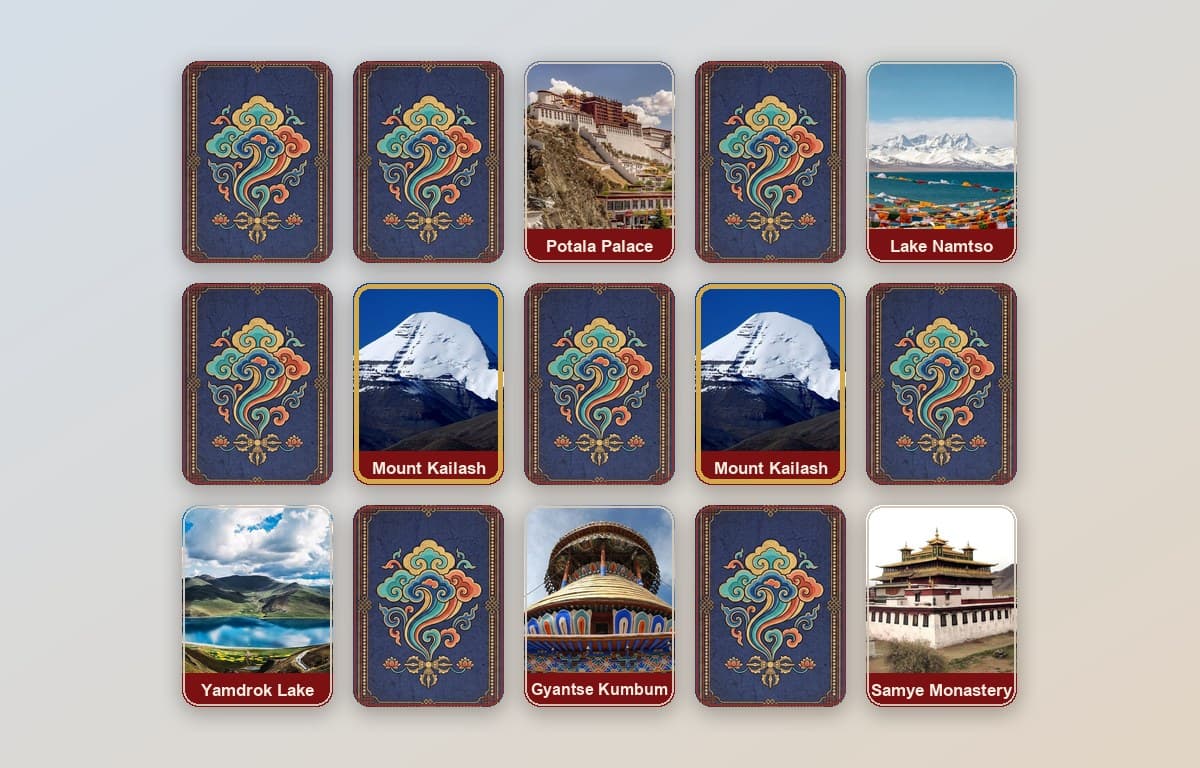
A memory game is really a game of seeing — you win by looking closely and remembering. So we asked: what would be worth remembering? Instead of the usual letters or cartoon animals, every card in this deck is a real place in Tibet. Turn a card over enough times to win, and those places quietly settle into memory — the shape of the Potala, the golden roof of the Jokhang, the white dome of Kailash.
For a child growing up far from Tibet, many of these are places they may never have seen. A gentle game is a warm way to meet them — to learn a name, notice a silhouette, and begin to carry a small map of the homeland in the mind.
What you'll meet
Fifteen places, one homeland
The deck draws from fifteen of Tibet's most beloved landmarks — palaces and temples, the great teaching monasteries, and the sacred mountains and lakes that pilgrims still circle today. Each round deals a fresh random mix, so no two games look quite the same.
How to play
Flip, match, remember
Turn over any two cards. If they show the same landmark, the pair stays and celebrates; if not, they flip back — so remember where each one was. Clear the board to win. Pick Easy, Medium or Hard for 6, 8 or 12 pairs.
Every win earns a Score from your moves and time, weighted by difficulty — the fewer flips and the faster you finish, the higher it climbs. A simple number to see who's the sharpest in the family.
The photographs are of the real landmarks they name. Swapping in your own pictures — family pilgrimage photos, a favourite monastery — is a one-line change, so this board can grow with you.